
State Runtime: the agent's world is an event-sourced belief log
Ran Tao (Octoryn Research)
Abstract
Design note: model agent world-state as an event-sourced belief log, not chat history. Outcome-free events (assert/update/supersede/retract) fold via a pure reducer to a belief state (state = reduce(events)); answers are served from the reduced state, and retracted or contradicted facts are never served confidently. It is positioned as the shared substrate beneath the clarification and skill runtimes (crystallize = assert, pre-bind = reduce) and is replayable and auditable. No measurements are reported; extraction quality and large-log scale behaviour are out of scope.
1. Contribution / Thesis
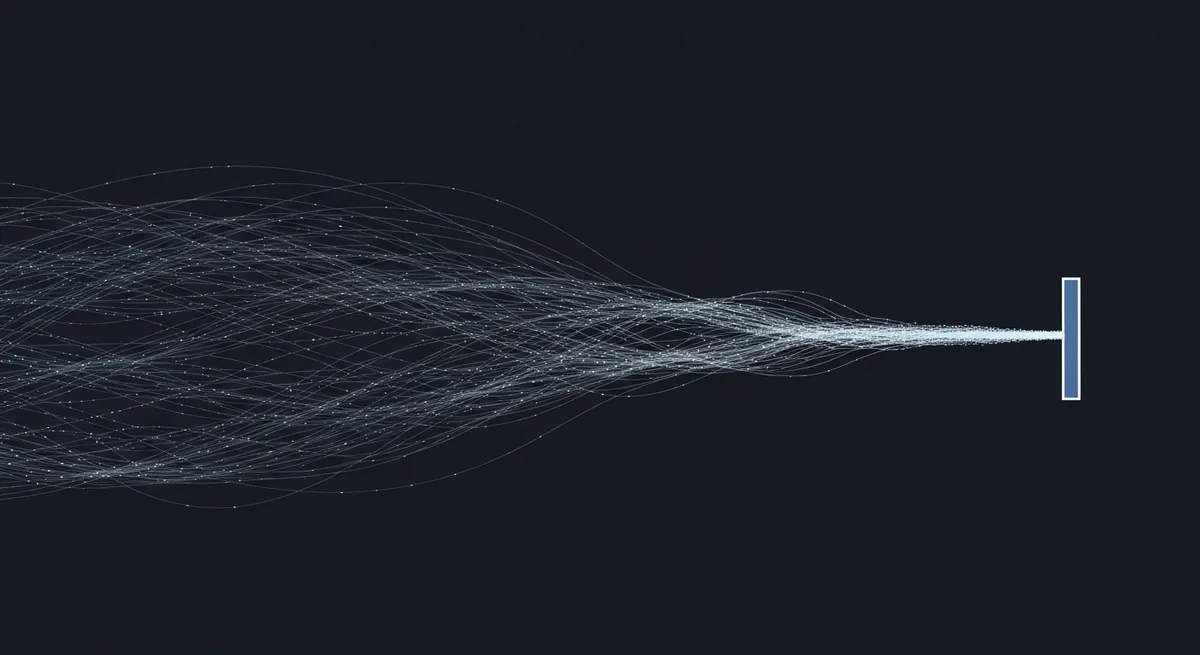
Claimed. State Runtime models an agent's world-state as an event-sourced belief log rather than as chat history. Small, outcome-free events — assert, update, supersede, retract — are folded by a pure reducer into a belief state (state = reduce(events)). The design contribution is a discipline: answers are served from the reduced state, never from the raw transcript, and a fact that has been retracted or contradicted is never served confidently. Because the log is event-sourced, world-state is replayable and auditable — one can ask not only what the agent believes but why and since when. The note positions this log as the shared substrate beneath the clarification and skill runtimes: crystallizing a resolved decision is an assert, repeat-task pre-binding is a reduce over those asserts, and retraction forces a re-ask.
NOT claimed. This is an architecture/design note, not an empirical result. It does not claim any measured throughput, latency, accuracy, or generation-quality number — none are reported. It does not claim automatic extraction of high-quality belief events from arbitrary conversation; only the reducer is described as implemented, and conversation-to-event extraction quality is explicitly out of scope. It does not claim any validated scale behaviour for large belief logs, nor a novel algorithm — event sourcing and CQRS-style reduce-from-events are established patterns; the contribution is their application to agent world-state with a zero-false-confident serving discipline.
2. Design
The core abstraction is a fold over an append-only event stream:
state = reduce(events)
Event vocabulary (outcome-free — events record beliefs about the user's world, not task results):
| Event | Meaning | Effect on reduced state |
|---|---|---|
assert | Establish a new belief | Belief becomes present in state |
update | Revise an existing belief | Newer value supersedes prior |
supersede | Replace a belief with another | Prior belief no longer authoritative |
retract | Withdraw a belief | Belief absent; must be re-asked |
Serving discipline: queries are answered from the reduced state, not the transcript. A retracted or contradicted fact is never served confidently (a zero-false-confident discipline applies directly).
Relation to the other runtimes (at a high level):
| Runtime operation | Belief-log primitive |
|---|---|
| Crystallization (clarification / skill) | assert the resolved decisions |
| Repeat-task pre-binding | reduce over those asserts |
| Retraction -> re-ask | retract removes the belief |
3. Evidence / Status
This note reports a design, not a benchmark. Status of each element, stated honestly:
- The reducer (
state = reduce(events)) and the four-verb event vocabulary are described as the implemented substrate. - Replayability / auditability follows structurally from append-only event sourcing.
- The integration with the clarification and skill runtimes is asserted as a design relationship; no measurement is recorded in the source.
- Conversation-to-event extraction is explicitly identified as a separate, unproven concern.
The note's evidenceLevel is carried forward as experimental; readers should treat that label as describing the engineering substrate rather than any quantitative experiment, since this note contains no measurements (see Limitations).
4. Limitations
A skeptical reviewer should note:
- No empirical evaluation. This note contains zero measurements — no sample size, no hardware, no oracle, no metric, no gate. It is a design description; its
evidenceLevel: experimentalis not backed by reported numbers in this note. - Extraction quality unproven. The reducer being correct says nothing about whether good belief events can be extracted from arbitrary conversation. Garbage events reduce to a garbage-but-auditable state.
- Parity of structure is not quality of answers. Serving from reduced state guarantees a discipline, not that the underlying beliefs are right.
- Scale unvalidated. No data on reduce cost, log growth, or compaction for large belief logs.
- Conflict semantics underspecified here. The precise resolution rules for concurrent
update/supersedeon the same belief are not detailed in the source. - Not novel as a mechanism. Event sourcing / fold-over-log is prior art; the contribution is the agent-memory framing and serving discipline, not the pattern itself.
5. Provenance / Relation
- Internal technical-report record, Octoryn Research, 2026. Author: Ran Tao.
- Substrate beneath the clarification and skill runtimes (crystallize =
assert, pre-bind =reduce). - Implementation: an ahead-of-time compiled native build targeting commodity consumer hardware, deliberately kept free of third-party machine-learning framework dependencies (numerical work delegated only to platform-native primitives).
- Build/run identifiers and version pins are not part of this design note (it specifies no build/run procedure).
Claim boundary
The author's explicit scope — what this work does and does not establish — carried over from the Octoryn Research publishing model.
Proves
- An agent's world-state can be modeled as an event-sourced belief log (assert/update/supersede/retract -> reduce -> state) where answers come from the reduced state and retracted facts are never served confidently.
- This belief log is described as a shared substrate for the clarification and skill runtimes (crystallize = assert, pre-bind = reduce) and is replayable and auditable.
Does not prove
- Automatic extraction of high-quality belief events from arbitrary conversation (only the reducer is described as implemented; extraction quality is separate).
- Scale behaviour of very large belief logs (no reduce cost, log growth, or compaction data).
- Any quantitative throughput, latency, accuracy, or generation-quality result (the note reports no measurements).
- That serving from reduced state makes the underlying beliefs correct (structural discipline is not answer quality).
Applies when
- Maintaining and querying agent world-state as an event-sourced belief log with a zero-false-confident serving discipline.
Does not apply when
- Claims about conversation-to-event extraction quality.
- Large-scale reduce or log-growth performance.
- Any benchmark-scale or quantitative evaluation (this is a design note with no measurements).
Authors
- Ran Tao — Investigation, Writing
Cite this
Citation
Tao, R., Octoryn Research. (2026). State Runtime: the agent's world is an event-sourced belief log (TR-2026-0027). Octopus Research.
BibTeX
@techreport{oritr20260027,
  title       = {State Runtime: the agent's world is an event-sourced belief log},
  author      = {Tao, Ran and {Octoryn Research}},
  institution = {Octopus Research},
  year        = {2026},
  note        = {Permanent ID TR-2026-0027. Not peer reviewed.}
}
Disclosures
- Funding
- Hardware and infrastructure provided by Octoryn / Octopus Core Pty Ltd.
- Conflicts of interest
- Octoryn ships commercial inference and governance tooling; findings are reported independently.